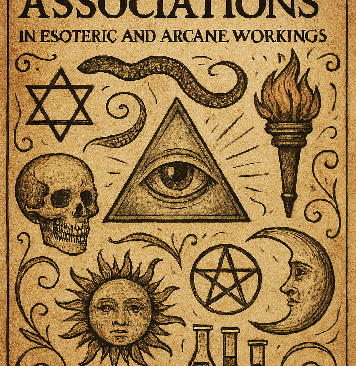
The Role of Correspondences in Witchcraft
Witchcraft is often described in poetic language — moonlight, candles, herbs, whispered words. Outsiders sometimes assume these details are decorative, or that they exist purely for atmosphere. But within the craft, these elements are neither arbitrary nor ornamental. They are tools. More importantly, they are chosen tools, selected with intention because each one shapes the energy, focus, and direction of the work.
This post offers a simple orienation to the role of correspondences in spellcraft: not an exhaustive catalogue, but a clear sense of why witches pay such close attention to colours, scents, words, materials, and timing. Think of it as a map of the logic behind the practice.
- Spellcraft is deliberate, not aesthetic
A well‑crafted spell is not a collage of mystical objects. It is a structured act. Every component — from the colour of a candle to the phrasing of a spoken charm — is chosen because it supports the purpose of the working.
These choices are not about superstition. They are about focus. Human beings respond to symbols, sensory cues, and ritual structure. Witches use that fact consciously. The elements of a spell create a mental and emotional environment that aligns the practitioner with the intention they are raising.
The key point: Spellcraft is intentional design, not decoration.
- Correspondences shape the atmosphere of the work
Most traditions of witchcraft rely on a network of correspondences: colours, herbs, stones, planetary hours, moon phases, and so on. These correspondences are not fixed laws but practical tools. They help the witch build an atmosphere that supports the desired outcome.
For example:
- Colours can evoke emotional states or symbolic qualities.
- Herbs and resins carry long‑standing ritual uses rooted in their scent, history, or energetic “feel.”
- Words act as anchors for intention — spoken rhythmically, they steady the mind.
- Tools like bowls, knives, or cords provide structure and physical engagement.
None of these elements “cause” the result on their own. They create the conditions in which focused intention can be raised and directed.
- The senses are gateways to intention
A spell is not purely intellectual. It is embodied work. The senses play a central role because they draw the practitioner fully into the moment.
- The smell of incense signals transition.
- The warmth of a candle flame sharpens attention.
- The texture of herbs or soil grounds the work in physical reality.
- The sound of chanting or breath creates rhythm and momentum.
These sensory cues are not distractions — they are the scaffolding that supports concentration. They help the witch enter the state of mind where intention becomes steady, coherent, and potent.
- Structure strengthens focus
A spell is, in many ways, a ritual container. The correspondences chosen for the working give it shape. They mark a beginning, a middle, and an end. They help the practitioner move from ordinary awareness into a focused state and back again.
This structure matters because intention is not a vague wish. It is a directed act of will. The more clearly the elements of the spell reinforce that direction, the more effective the work becomes.
- Correspondences are a language, not a rulebook
Different traditions use different correspondences. What matters is not universal agreement but internal coherence. A witch chooses elements that speak the same symbolic language, forming a unified field of meaning.
This is why experienced practitioners often develop personal correspondences alongside traditional ones. Over time, certain scents, colours, or phrases become deeply linked with specific intentions. These personal correspondences can be just as powerful as inherited ones, because they resonate directly with the practitioner’s own psyche.
- The craft grows through practice
Correspondences are not memorised for their own sake. They are learned through use. Over time, a witch discovers which combinations sharpen focus, which scents open the heart, which colours steady the mind, and which words carry weight.
This is the quiet, practical side of witchcraft — the part that rarely appears in popular portrayals. It is a craft built on observation, refinement, and respect for the subtle ways the human mind responds to symbol and ritual.
If you’re beginning to explore spellcraft, start simply:
- Choose a clear intention.
- Select a few elements that genuinely support it.
- Pay attention to how those elements affect your focus and state of mind.
Witchcraft is not about collecting exotic tools. It is about learning how to shape your inner landscape with care. Correspondences are the vocabulary of that shaping — a language of colour, scent, sound, and symbol that helps the witch bring intention into form.